
There’s a moment in every academic paper on sex work where the tone shifts. Not because of new data, but because someone, somewhere, decided to name it. Not ‘sex work.’ Not ‘commercial intimacy.’ Not even ‘prostitution.’ They called it Schrodinger’s whore. The phrase isn’t in any dictionary. It doesn’t appear in legal codes. But in graduate seminars in Paris, Berlin, and Toronto, it’s whispered like a secret only those who’ve read Foucault and watched Call Me by Your Name can understand. It’s a metaphor: the worker is both real and not real, visible and invisible, criminal and commodified-all at once. Until you observe her, she exists in superposition. And when you do? The wave function collapses into a stereotype.
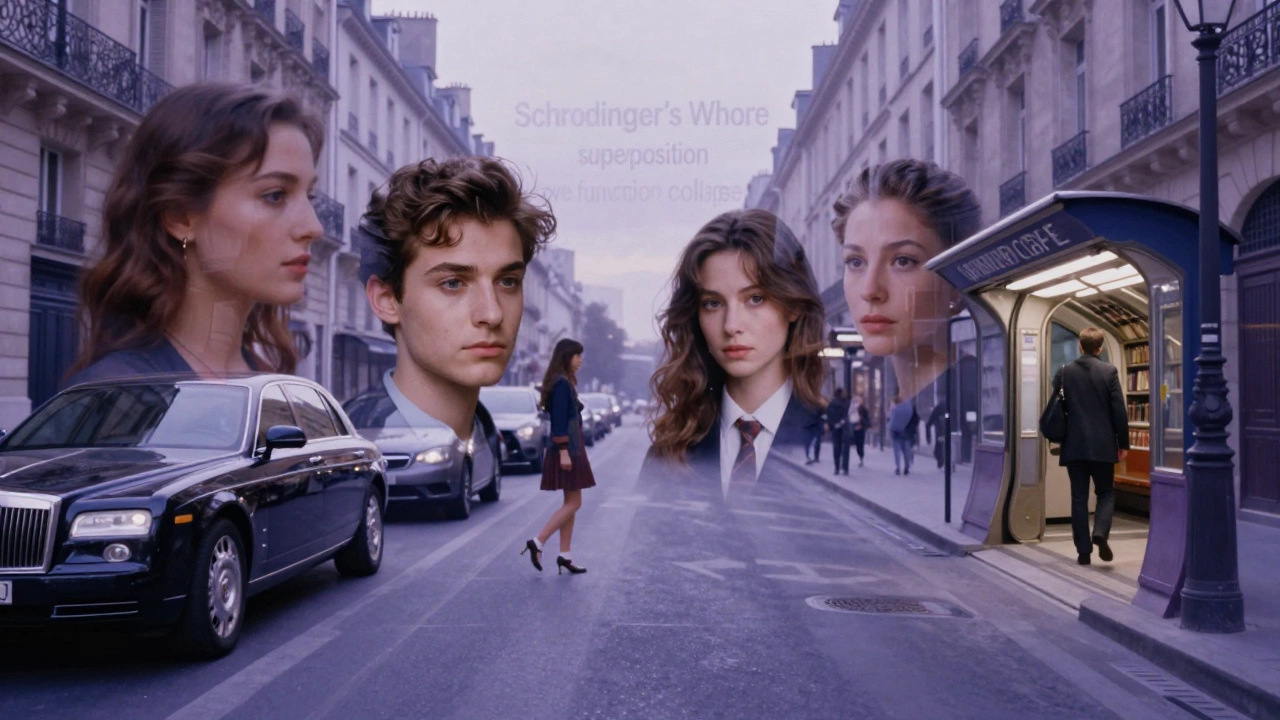
It’s easy to find photos online of women in Paris wearing stilettos and fur coats, posing beside luxury cars. Some of them are real. Some are stock images. Some are AI-generated. One site, escor girl paris, mixes them all together-blurring the line between fantasy and reality so thoroughly that even the women themselves might struggle to recognize their own faces. This isn’t just about tourism or advertising. It’s about how society visualizes labor that refuses to be neatly categorized. The woman in the ad isn’t a person. She’s a symbol. A placeholder. A Schrodinger’s whore.
Who Gets to Define the Terms?
Academics love to debate language. They’ll spend years arguing whether ‘prostitute’ is offensive, whether ‘sex worker’ is too sanitized, whether ‘escort’ is a euphemism or a reclamation. But few ask: who gets to name the person behind the term? In France, where sex work is legal but soliciting is not, the state doesn’t recognize ‘escort’ as a profession. No social security. No tax ID. No unemployment benefits. Just a legal gray zone where you’re neither criminal nor citizen.
Meanwhile, in university departments, researchers cite each other’s papers using terms like ‘commodified sexuality’ and ‘performative intimacy.’ They write about agency, autonomy, coercion. They use statistics from the French Ministry of Health and interviews from NGOs. But rarely do they include the voice of the woman who wakes up at 3 p.m., texts three clients before lunch, and then spends two hours editing her Instagram to look like she’s on vacation in Bali-when she’s actually in a studio apartment in the 18th arrondissement.
The Parisian Mirage
Paris is the epicenter of this paradox. The city sells itself as romantic, artistic, liberated. Its streets are lined with boutiques that charge €800 for a handbag and €40 for a coffee. And somewhere between the Chanel stores and the metro entrances, women who call themselves ‘escorts’ wait for calls. They don’t advertise on billboards. They don’t need to. Their presence is coded: the way they walk, the way they smile at men in suits outside Le Bon Marché, the way they disappear into elevators without looking back.
Some are students. Some are single mothers. Some are immigrants who arrived with nothing but a suitcase and a French phrasebook. They don’t see themselves as ‘sex workers.’ They see themselves as people trying to pay rent. But the language of academia, and the language of the internet, insist on labeling them. And when you label someone, you erase their complexity. That’s when Schrodinger’s whore becomes real-not because she exists, but because we stopped seeing her as human.
On Instagram, you’ll find accounts with titles like ‘Paris escrot’ or ‘escort girl pariq.’ These aren’t typos. They’re algorithms. They’re SEO traps. They’re designed to catch people searching for ‘Paris escort’ or ‘luxury companion Paris.’ The misspellings aren’t mistakes-they’re tactics. They bypass filters. They avoid detection. And they work. Thousands of clicks a month. Thousands of dollars in payments. Thousands of lives reduced to search terms.
Academia’s Blind Spot
There’s a reason no major university in France offers a course called ‘Sex Work and the Digital Economy.’ It’s too messy. Too political. Too uncomfortable. Instead, sociology departments offer classes on ‘gender and labor,’ where students read Judith Butler and bell hooks. They learn about the commodification of the body. They write essays about how capitalism turns intimacy into product. But they never meet a woman who does this for a living. They never hear her say, ‘I don’t want your pity. I want my paycheck.’
Meanwhile, the women themselves are writing their own research. Not in journals, but in DMs. Not in footnotes, but in WhatsApp threads. They share tips: which clients pay on time, which neighborhoods are safe after dark, which apps still work after the latest crackdown. They archive screenshots of blocked accounts. They create private databases of police raids. This is the real data. Not the surveys from NGOs. Not the interviews filtered through institutional ethics boards. This is the ground truth.

The Algorithmic Erasure
Google doesn’t show you the real Paris. It shows you curated versions. When you search ‘Paris escort,’ you get ads for luxury dating sites. When you search ‘Paris sex worker,’ you get articles from 2012 about human trafficking. When you search ‘escor girl paris,’ you get a website that looks like a fashion blog but is really a front for a booking service. The algorithm doesn’t care about truth. It cares about clicks. And the more people search for these misspelled terms, the more the system reinforces them.
It’s not just Google. Instagram, OnlyFans, Telegram-all of them have policies that ban ‘sex work’ but allow ‘personal companionship.’ So the women adapt. They post photos of themselves holding coffee cups. They write captions about ‘networking in Paris.’ They use emojis instead of words. One woman posted a picture of a Chanel bag with the caption: ‘New acquisition. Thanks for the support.’ No one questioned it. Not the platform. Not the followers. Not the academics who later cited it as an example of ‘aestheticized labor.’
What’s at Stake?
When we reduce a person to a metaphor, we stop seeing their pain. When we reduce a profession to a keyword, we stop seeing their humanity. Schrodinger’s whore isn’t a theory. It’s a living, breathing woman who wakes up every day and decides whether to show up for her clients or to take the day off because she’s tired. She doesn’t need a PhD to understand her own worth. But she does need us to stop pretending her existence is abstract.
Academia has the power to change laws. It has the power to shift public perception. But only if it stops talking about people and starts listening to them. Only if it stops using terms like ‘prostitute’ and ‘escort’ as if they’re neutral. Only if it stops treating Paris as a backdrop for intellectual performance and starts treating it as a place where real people live, work, and survive.
The next time you read a paper that uses the phrase ‘Schrodinger’s whore,’ ask yourself: who is this woman? Where is she right now? Is she sleeping? Is she waiting for a message? Is she wondering if she’ll make rent this month? And if you don’t know the answer, maybe the problem isn’t with her. Maybe it’s with the way we’re looking.